
Basement Contractor Licensing and Insurance in Colorado: What to Verify Before You Sign
Before you hand anyone a deposit for your basement finishing project, you need proof of two things: a valid contractor license for your city and active insurance coverage. Contractor license verification is a critical step that homeowners often skip, but skipping it creates real risk. Basement contractor licensing insurance requirements in Colorado confuse a lot of homeowners, because Colorado handles licensing differently than most states. There is no statewide general contractor license here. Instead, each city and county runs its own licensing program, which means the rules in Aurora are not the same as the rules one town over. This guide explains how it works, what to ask for, and how to spot the contractor who is cutting corners before the check clears.
We wrote this from the contractor's side of the table. A trustworthy local company wants you to ask these questions, because the contractors who lose work when homeowners get careful are the ones who should lose it.
Why Colorado Licensing Works Differently Than You Expect
Colorado does not issue a statewide general contractor license. The state licenses electricians and plumbers at the state level, but general contractors get licensed city by city and county by county. So when a basement remodeling company tells you they are "licensed in Colorado," that phrase means less than it sounds like it means. The real question is whether they hold a current contractor license with the City of Aurora, because that is the jurisdiction that will issue your basement remodeling permit and inspect the work.
This local structure matters for a practical reason. A contractor who works mostly in another metro may not hold an Aurora license at all. Large multi-city companies sometimes pull permits under a license registered somewhere else, or they lean on a subcontractor's license and hope nobody checks. Either way, if the license does not match the company name on your contract, you have a gap that becomes your problem the moment something goes wrong.
There is one bright line inside all this local variation. Electrical and plumbing work in Colorado requires state-licensed tradespeople no matter which city you live in. Your basement finish will almost certainly include new circuits, outlets, lighting, and often a bathroom rough-in. Whoever does that work needs the right state license, and the permits for those trades get inspected separately. A finish contractor who shrugs when you ask who is doing the electrical is telling you something.
Steps for Proper Contractor License Verification
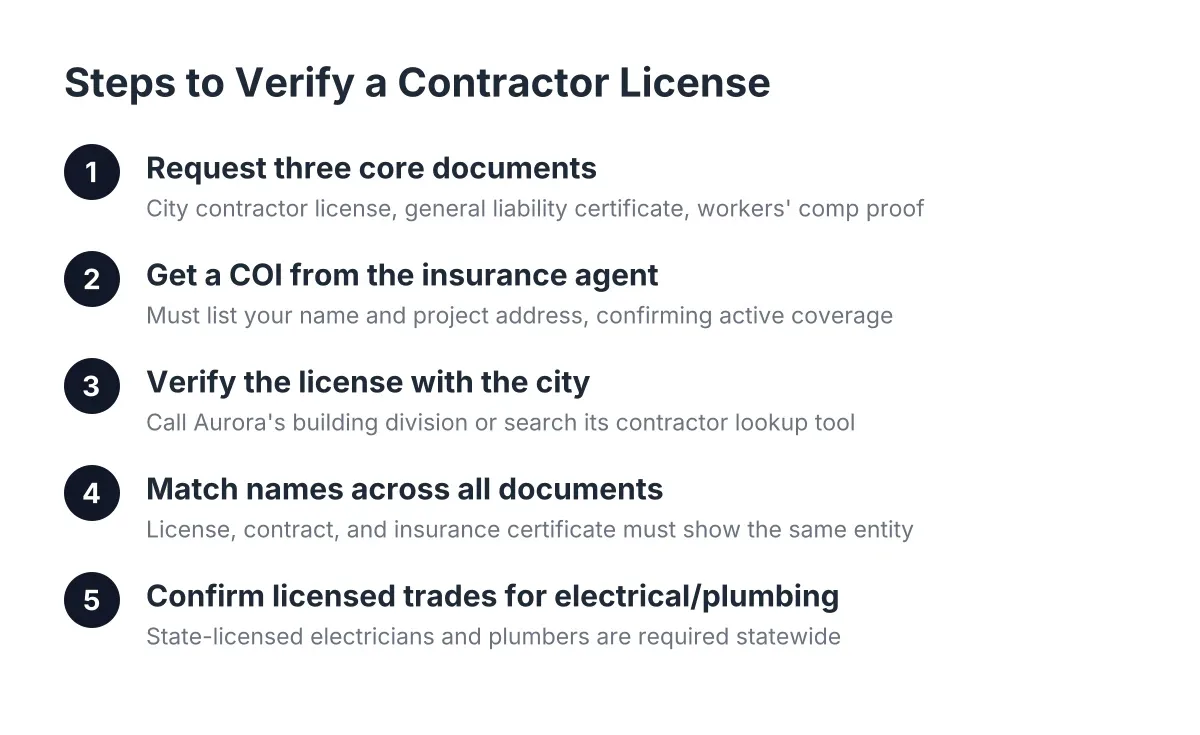
A properly set up basement contractor in Aurora can show you three documents without hesitation: a current City of Aurora contractor license, a certificate of general liability insurance, and proof of workers' compensation coverage if they have employees. Ask for all three before you sign anything. A legitimate company sends these the same day you ask, because they get asked constantly.
Here is what each document does for you:
- City contractor license. This proves the company is registered with Aurora's building division and can legally pull your basement remodeling permit under their own name. It also means the city has a record of who they are if a dispute arises.
- General liability insurance. If the crew cracks a water line and floods your storage room, or damages the furnace while framing around it, this policy pays for the damage. Without it, you are chasing the contractor personally for the money.
- Workers' compensation. If a worker gets hurt in your basement and the contractor carries no workers' comp, the injured worker's attorney can look to you, the homeowner, for recovery. This is the risk most homeowners never think about until it lands on them.
Do not settle for a verbal "yes, we're covered." Ask for a certificate of insurance, called a COI, sent directly from the contractor's insurance agent with your name and project address listed. A COI from the agent confirms the policy is active today, not a policy that lapsed six months ago and lives on as a PDF in the contractor's email.
One more check that takes five minutes: call Aurora's building division or search the city's contractor lookup and confirm the license is current and in the company's legal name. Match that name to the name on your contract and on the insurance certificate. All three should be the same entity. When they are not, ask why, and listen closely to the answer.
Licensed vs. Unlicensed: What You Actually Risk
Hiring an unlicensed basement contractor in Aurora risks unpermitted work, no insurance backstop, failed inspections, and trouble at resale. The city can require you to open finished walls for inspection or remove work entirely. Since permits get pulled under a license, an unlicensed contractor usually means an unpermitted project, and those two problems travel together.
The discount an unlicensed contractor offers is real, and that is exactly why this trap works on budget-conscious homeowners. Suppose a homeowner in southeast Aurora gets two quotes for the same 900 square foot basement finish. One comes from a licensed basement remodeling company that includes permit fees, licensed electrical and plumbing subs, and inspection scheduling. The other comes in noticeably lower from a crew that says permits "aren't really needed for basements" and asks for half the money up front in cash. In that scenario, the cheaper quote is not the same project at a better price. It is a different project, one where the electrical work never gets inspected and the homeowner holds all the risk.
That risk shows up at resale, which matters if you are finishing a basement partly for the equity. A national basement remodel returns 71% of its cost at resale on average, the highest ROI among newly tracked project categories in the 2025 Cost vs. Value Report, according to JLC (Journal of Light Construction) Cost vs. Value Report. However, that return assumes the finished space counts as legal living area. An unpermitted basement bedroom without a proper egress window cannot be listed as a bedroom, and a buyer's inspector will flag unpermitted work. You spent the money either way; only the permitted version pays you back.
There is a middle case worth naming honestly. Some skilled tradespeople do good work without holding a local license, often because they mainly sub for larger companies. The work itself might be fine. The problem is structural: no license means no permit in their name, no inspection record, and no insurance certificate you can verify. You are betting your project on nothing going wrong, and basements are where things go wrong quietly, behind drywall, over years.
Permits, Inspections, and Why the Contractor Should Pull Them
Your contractor should pull the basement remodeling permit under their own license, not ask you to pull it as an owner-builder. This is one of the clearest tells in the whole hiring process. When a contractor pulls the permit, the city holds that contractor accountable for the work and the inspections. When you pull it as the homeowner, you take legal responsibility for code compliance on work you did not perform.
Contractors who push homeowner-pulled permits usually give a friendly reason. They say it saves you money, or it speeds things up. What it actually does is shift liability off their license and onto you. A contractor confident in their work wants their name on the permit, because passing inspections under their own license is how they keep that license in good standing.
Expect multiple inspections during a typical Aurora basement finish, not one visit at the end. In practice, the sequence usually includes an electrical rough-in inspection early, then an insulation inspection before drywall goes up, and a final inspection when the work is done. Fire blocking in wall and ceiling cavities gets checked during the insulation phase, and it is a common failure point for crews that do not finish basements regularly. A contractor who can walk you through this inspection sequence for Aurora specifically, without checking notes, has done this here before.
Egress is the other code area where basement experience shows. Under the IRC 2024 code, every basement sleeping room needs an emergency escape and rescue opening with a minimum 5.7 square feet of net clear opening area, among other simultaneous size criteria, according to EgressUSA. Egress openings also require a maximum sill height of 44 inches above the finished floor and a minimum net clear opening width of 20 inches, according to The Great Egress Co. Egress window sizing is not a detail to improvise. If your plan includes a basement bedroom, ask each contractor how they handle egress window installation and whether the cost of cutting the opening and installing the well is in the quote. A basement escape window added mid-project as a change order is a budget surprise you can avoid by asking now.
How to Compare Quotes Once Licensing and Insurance Check Out
Once every bidder has passed the basement contractor licensing insurance check, compare quotes on scope, not just the bottom line. Wildly different quote totals usually mean wildly different scopes, and the itemized breakdown tells you which contractor thought your project through. A low number with a vague scope is where surprise change orders come from.
If you are trying to build a realistic budget before you talk to anyone, that is a fair goal, and it is exactly why itemized quotes matter more than headline totals. The cost to finish a basement moves with the specifics of your house: ceiling height, moisture conditions, whether an egress window needs to be cut, how far the bathroom is from the main stack, and the finish level you want. Two honest quotes on the same basement can differ for legitimate reasons. Your job is to find out which reasons apply.
Ask each basement finishing company to break the quote into these pieces:
- Design and permit costs, including who pulls the basement remodeling permit and pays the fees.
- Framing, insulation, and fire blocking, with the insulation approach spelled out.
- Electrical and plumbing, with the names or license status of the subs doing that work.
- Egress window installation, if your layout includes a bedroom, listed as its own line.
- Drywall, paint, flooring, doors, and trim, with the specific materials or allowances named.
- A written change order process, so mid-project additions get priced and approved before work happens.
Moisture deserves its own question in every quote conversation. More than 60% of U.S. homes with basements experience some degree of water penetration or moisture problems, according to American Society of Home Inspectors. Any contractor who quotes your basement without asking about damp spots, past water events, or the condition of the slab is quoting a basement they have not thought about. Insulating over an unresolved moisture problem locks the problem behind drywall, where it degrades the assembly instead of drying out. The right contractor addresses drainage and moisture first, then insulates, and the quote should reflect that order.
Watch how each company handles your existing conditions too. Say your basement came with old framed walls and fiberglass stuffed against the concrete by a previous owner. A careful contractor will often recommend tearing that assembly out and starting clean rather than building on top of it, because hidden moisture and improper insulation against concrete cause more damage later than the demo costs now. The contractor who says "we'll just work with what's there" on every question is optimizing for the lowest bid, not the best basement.
Questions That Separate Local Pros From Everyone Else
Five questions reveal whether a basement remodeling company actually knows Aurora: ask about their Aurora license, their insurance certificate, the local inspection sequence, egress window code compliance, and recent finished basements nearby. A local pro answers all five in plain language. A company running generic city pages stumbles on at least two. During your contractor license verification process, pay close attention to how each candidate responds to these questions.
Here is how the answers should sound. On licensing, you want a current Aurora license number you can verify with the city, not a vague reference to being licensed "in the Denver metro." On insurance, you want a COI from their agent within a day. Additionally, on inspections, you want the rough-in and insulation sequence described from memory. Furthermore, on egress, you want specific talk about net clear opening, sill height, and window well requirements, not "we'll figure it out."Notably, on local work, addresses or neighborhoods in Aurora where they finished basements recently.
If you are searching phrases like basement remodeling near me and sorting through basement remodeling companies, this five-question filter does most of the vetting work for you. It is faster than reading a hundred reviews, and harder to fake. Reviews still help; look for ones that mention permits, inspections, and how change orders were handled, since those reveal how a company behaves when the project gets complicated.
There are limits to what any checklist covers. If your basement has structural cracks, active water intrusion, or radon concerns, bring in the relevant specialist before any finishing contractor starts framing. Finishing work cannot fix a structural or water problem, and the honest contractors will tell you the same thing.
Putting It Together Before You Sign
The homeowners who get burned on basement projects almost never get burned by bad drywall. They get burned by the paperwork they skipped: no license verification, no insurance certificate, no permit, no itemized scope. Every one of those checks takes minutes, and every legitimate basement finishing company in Aurora passes them without friction. The pattern to internalize when hiring a basement contractor is simple: verify first, compare scopes second, and only then compare prices.
Colorado's city-by-city system puts more verification work on you than a statewide license would, but it also gives you a clear place to check: Aurora's own building division. Confirm the license, demand the COI, insist the contractor pulls the permit, and get every scope item in writing. A contractor with clean basement contractor licensing insurance answers, a specific inspection plan, and a line-item quote has already shown you how the rest of the project will run.
Get at least two or three itemized quotes, use a free estimate to pressure-test your budget against your actual basement, and do not let the lowest number make the decision by itself. The cheapest quote and the best value are sometimes the same contractor. You will only know after the paperwork checks out.
If you need basement finishing, Aurora Basement Finishing Pros can help.
Prefer to talk it through? Call (720) 973-5727 — a quick call is usually the fastest way to get a straight answer for your situation.