
Basement Remodeling Financing Options: 7 Ways Aurora Homeowners Pay for a Finish
Most Aurora homeowners do not pay cash for a basement finish. They use one of several basement remodeling financing options, and the one you pick can change the total cost of the project by thousands of dollars over the life of the loan. This matters whether you are a hands-on homeowner doing the drywall yourself and hiring pros for electrical and egress, or a small landlord adding a legal basement bedroom to collect rent.
Here are seven realistic ways to pay for a basement remodel, with the trade-offs spelled out plainly. None of these is the right answer for everyone. The goal is to walk into a lender conversation, or a contractor conversation, knowing which option fits your project and your plans for the house.
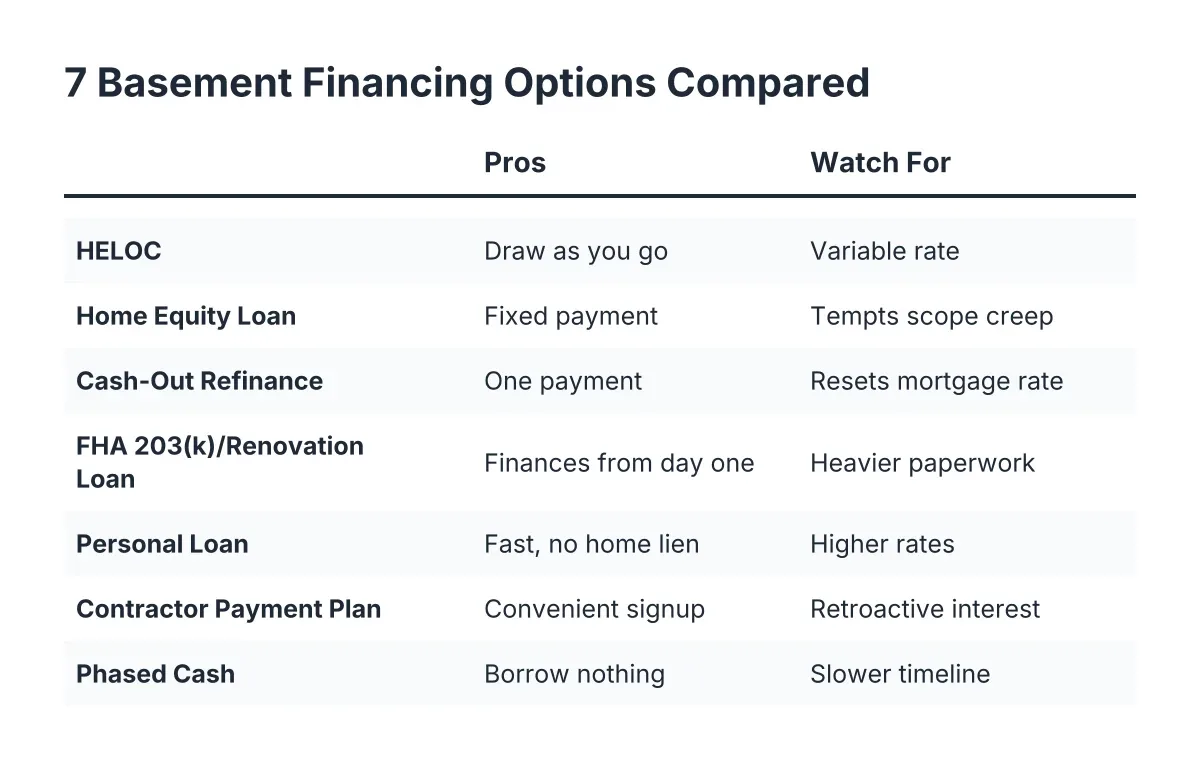
1. Home Equity Line of Credit (HELOC): Pay as the Project Moves
A HELOC lets you borrow against the equity in your home and draw funds only as you need them. For a basement finish, that structure fits how the work actually happens. You pay the egress window installer in month one, the electrician in month two, and buy your own drywall in month three, drawing only what each stage requires.
The trade-off is that most HELOCs carry variable rates, so your payment can rise if rates climb. The house also secures the debt, which means missed payments put your home at risk. For a Permit-Wary DIYer splitting the project between pro work and sweat equity, the draw-as-you-go flexibility usually outweighs the rate uncertainty, since you may not know your final spend until the city signs off on your inspections.
2. Home Equity Loan: A Fixed Number for a Fixed Scope
A home equity loan gives you a lump sum at a fixed rate with a fixed monthly payment. It works best when your scope is locked down before you borrow. If a contractor has walked your basement, measured for egress window sizing, and given you a written estimate covering framing, electrical, and finishes, you know the number you need.
However, a lump sum tempts scope creep. Money sitting in your account has a way of turning a three-room finish into a wet bar and a steam shower. Borrow against a real written estimate, not a guess, and hold back a cushion for surprises behind the walls. This is where a free estimate from a local basement finishing contractor earns its keep; it gives the lender and you the same concrete number.
3. Cash-Out Refinance: One Mortgage, One Payment
A cash-out refinance replaces your current mortgage with a larger one and hands you the difference in cash. It consolidates everything into a single payment, often at a lower rate than unsecured borrowing. For a house-hacker planning a basement rental unit, rolling the finish cost into the mortgage keeps the monthly math simple when you compare it against expected rent.
The catch in 2026 is your existing rate. If you locked a low mortgage rate years ago, refinancing the entire balance to pull out remodel money can cost far more over 30 years than a second loan would. Run both numbers before you sign. A cash-out refi only makes sense when the new blended rate still beats what a HELOC or home equity loan would cost you on the remodel portion alone.
4. FHA 203(k) and Renovation Loans: Financing Built Around Permitted Work
Renovation loans like the FHA 203(k) fold the remodel cost into the mortgage at purchase or refinance, and they require the work to be documented, permitted, and inspected. If you just bought a house in Aurora with an old unfinished basement and want to add a bedroom, this route finances the finish from day one.
For example, suppose a buyer closes on a 1970s Aurora ranch with an unfinished basement and wants a conforming bedroom down there. A renovation loan could fund the basement remodeling permit fees, the egress window installation, and the full finish inside one mortgage. The paperwork is heavier and the lender will want licensed contractors on the technical trades, which limits how much you can DIY. For a landlord who needs the basement bedroom to be legal anyway, that structure is a feature, not a bug. A legal bedroom needs a code-compliant basement escape window; under the IRC 2024 code, every basement sleeping room must have an emergency escape opening with at least 5.7 square feet of net clear opening, according to EgressUSA.
5. Personal Loans: Fast Money for Smaller Scopes
An unsecured personal loan funds in days, requires no home equity, and does not put your house on the line. That makes it a fit for smaller, targeted scopes. Say you plan to frame, hang drywall, and paint yourself, and you only need to finance the pro work: an egress window cut and install, a licensed electrician for the rough-in, and the HVAC tie-in. A personal loan can cover that package without touching your mortgage.
The downside is price. Personal loan rates run higher than home equity rates because the lender has no collateral. Keep the term short and the amount tight to the pro-work estimate. As a planning note for the DIY portion, remember the city will inspect in stages; basement projects typically get an electrical rough-in inspection first and an insulation inspection later, so your financing should cover the trades before you ever buy drywall.
6. Contractor Payment Plans: Convenient, but Read the Fine Print
Many remodeling contractors offer payment plans through third-party lenders, and some national operations push same-as-cash promotions hard. These plans are convenient because the paperwork happens at the kitchen table during the sales visit. Deferred-interest offers can work if, and only if, you pay the full balance before the promotional window closes.
Be careful here. Deferred interest often means retroactive interest; miss the payoff date by a month and you can owe interest back to day one at a steep rate. Also watch for financing baked into an inflated bid. When comparing basement remodeling financing options offered through a contractor against a bank loan, compare the total project price plus total interest, not just the monthly payment. A straightforward local contractor should be willing to quote the same cash price whether you finance or not.
7. Phased Cash: Finish in Stages, Borrow Nothing
Paying cash in phases is the slowest option and the cheapest one. You fund the project stage by stage: egress window and permits this year, framing and electrical next, drywall and trim after that. Since the city inspects a basement finish in stages anyway, a phased build can line up with the inspection sequence instead of fighting it.
The trade-offs are time and exposure. A half-finished basement earns no rent, and an open permit that sits too long may need renewal. Material prices also move; when lumber or drywall prices are spiking, waiting for them to settle can save real money, but a long pause mid-project can cost more than it saves. Phasing works best for an owner-occupant with no rental deadline. A landlord losing a year of basement rent to save on interest usually comes out behind.
Comparing Basement Remodeling Financing Options Before You Borrow
Comparing basement remodeling financing options comes down to four questions: what is the true all-in cost of the money, how fast do you need it, does the lender's structure fit a permitted and inspected project, and what happens to your plans if the project runs over. Answer those four before picking a lender, not after.
Work through this checklist with any option on your shortlist:
- Total borrowing cost over the full term, not the monthly payment
- Fixed or variable rate, and what a rate jump does to your budget
- Whether funds come as a lump sum or as draws matching project stages
- Whether the lender requires permits, inspections, or licensed contractors
- Prepayment penalties if rent income lets you pay it off early
- How much cushion remains for surprises like moisture fixes or added trim
That last point deserves emphasis. Moisture is common; more than 60 percent of U.S. homes with basements have some degree of water penetration or moisture problems, according to the American Society of Home Inspectors. A moisture fix found mid-project is exactly the kind of overrun that breaks a borrowed-to-the-penny budget. Homeowners also routinely underestimate trim; a finished basement can carry far more baseboard and casing than a typical room, and that shows up in the final bill.
Get a Real Number Before You Get a Loan
Every financing option above works better with an accurate project number behind it. Lenders ask for one, and guessing leads to either borrowing too much and paying interest on money you did not need, or borrowing too little and stalling at the drywall stage. National averages will not give you that number, because basement finishing cost depends on your square footage, your ceiling height, whether the space needs a new basement escape window, and how much of the work you plan to do yourself.
Therefore, the practical order of operations is this: get a written local estimate first, confirm what your basement remodeling permit and egress requirements will add, then shop financing against that real figure. In Aurora, a free estimate from a local basement finishing contractor costs you nothing and turns the lender conversation from a guess into a plan. One caution on the DIY side: loan structure does not change code. Electrical, HVAC, and egress window sizing are places to hire licensed pros regardless of how you pay, and a lender or city inspector will expect it. For tax questions, such as whether interest on home equity debt used for a remodel is deductible in your situation, talk to a tax professional before you borrow.
If you need basement finishing, Aurora Basement Finishing Pros can help.
Prefer to talk it through? Call (720) 973-5727 — a quick call is usually the fastest way to get a straight answer for your situation.